What Was the Contemporary Latter-day Saint View of Abraham Lincoln?
Abraham Lincoln was the sixteenth president of the United States (1861 to 1865). Some believe that Lincoln was “a man inspired of God who invoked a covenant relationship between America and its maker” and that he played a “crucial role … to bring this nation closer to heaven.”
And because Lincoln checked out the Book of Mormon from the Library of Congress, some wonder, “Did it influence him? Was the Book of Mormon a key factor in Lincoln’s success and the healing of a nation?” But Lincoln didn’t just check out the Book of Mormon, he also checked out some anti-Mormon books such as: “Mormonism in All Ages” by J.B. Turner and “Mormonism; Its Leaders and Designs; Portraits and Views” by John Hyde, Jr.
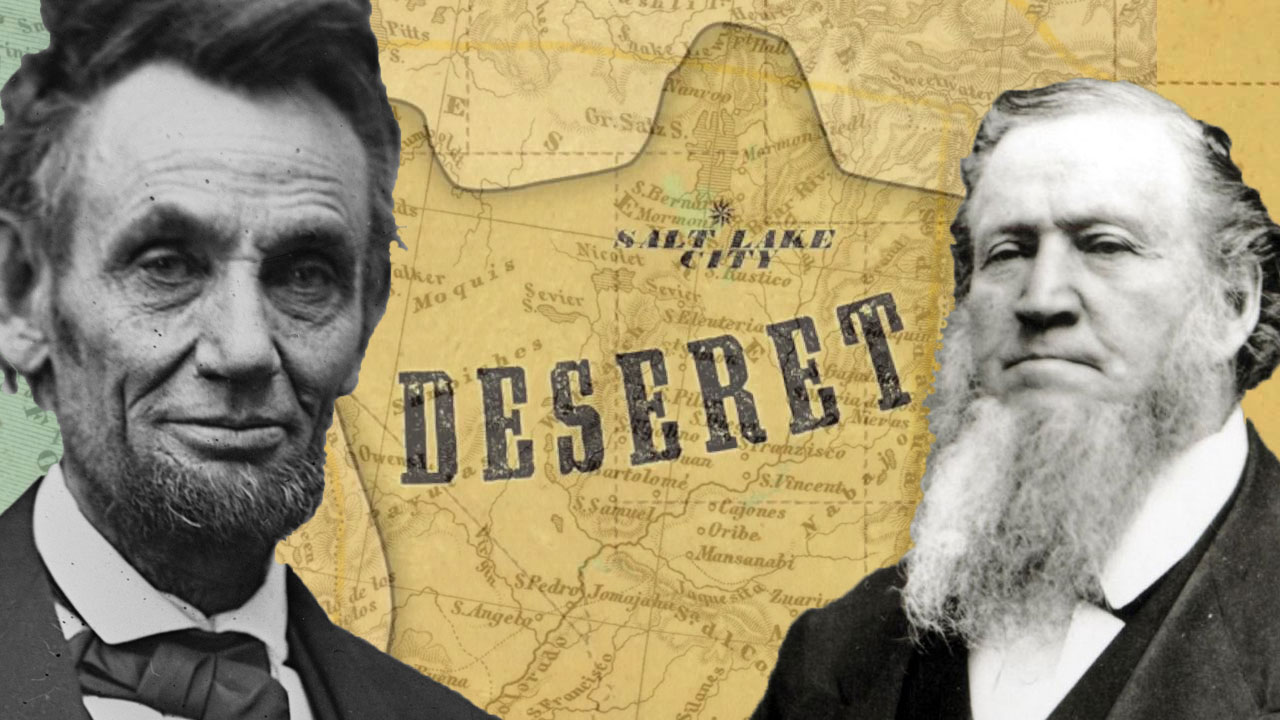
Does the contemporary historical record reveal Lincoln to be a friend or a foe to the Latter-day Saints?
To answer these questions it would seem necessary to provide some historical background and context regarding Abraham Lincoln’s dealings with the Latter-day Saints. Lincoln served four terms in the Illinois House of Representatives (1834-1842) and was later elected to the U.S. House of Representatives (1847–1849). From 1839 to 1846, the headquarters of The Church of Jesus Christ of Latter-day Saints was located in Nauvoo, Illinois.
Brigham Young said that:
Abe Lincoln was no friend of Christ, particularly, he had never raised his voice in our favor when he was aware that we were being persecuted. He was acquainted with Joseph & Hyrum [in Illinois], and had been a Master Freemason.[1]
Furthermore, Brigham Young stated:
If the Kingdom of God was not in the way, Abraham was [a] pretty good man, but he acted as if he would rather the Kingdom of God was out of the way; he was not the man to raise his voice in favor of Joseph Smith when his enemies were persecuting him. He with many others had assented to the deaths of innocent men, and through that he is subject to the influence of a wicked spirit.[2]
The Latter-day Saint pioneers arrived in the Salt Lake Valley in 1847. Brigham Young was president of the Church from 1847 to 1877. Utah was initially named the Territory of Deseret before being established as the Territory of Utah, with Brigham Young as the first Governor. By 1857 the Federal government wanted Young removed from office. This resulted in the so-called “Mormon War” or “Utah War” and ended in 1858 with Brigham Young stepping down and Alfred Cumming (a non-Mormon) being appointed as governor. In 1861, President Lincoln appointed John Dawson (also a non-Mormon) as governor of Utah, continuing the practice of not allowing the people of Utah to choose their own representatives.
Governor John Dawson left Utah and his post as governor after only three weeks due to tensions with Utah’s citizens. Dawson had allegedly made “grossly improper proposals” to a Mormon widow named Albina Merrill Williams. Mrs. Williams had responded by thrashing him with a fire shovel.
The following are additional comments from Brigham Young about Abraham Lincoln:
Old ‘Abe’ the President of the U.S. has it in his mind to pitch in to us when he had got through with the South. President [Heber C.] Kimball observed that men that he had met with, whether they had little or much of the Spirit of God, were in favor of the South.[3]
We need not expect any thing sensible from them, for the spirit of wisdom is taken away from them. He remarked that Pres Lincoln and Congress appear not to realize that there is a war on hand. It is not so with the South — they are keen and alive.[4]
I will see them in hell before I will raise an army for them. Abe Lincoln has sent these men here to prepare the way for an Army. An order has been sent to California to raise an army to come to Utah. This is the reason why Ball came back. I pray daily that the Lord will take away the reigns of Government of the wicked rulers and put it into the hands of the wise and good. … I do and always have supported the Constitution but I am not in league with such cursed scoundrels as Abe Lincoln and his minions. They have sought our destruction from the beginning and Abe Lincoln has ordered an army to this Territory…[5]
The President [Brigham Young] discussed with him the wicked course the American Nation had taken with this people, observing the government was running into a despotism, and they were willing the government should be despotic while they were in power. The President observed that Abraham Lincoln was a sagacious man, but believed he was wicked.[6]
President Daniel H. Wells, Apostle and member of the First Presidency, stated:
Stephen A. Douglas was a far better man than President Abe Lincoln, for he knew [Lincoln’s] feelings were hostile to this people. Pres Wells acquiesced in these remarks.[7]
Elder George A. Smith made the following statements at the Tabernacle in Salt Lake City in 1861:
Abe Lincoln, the present President of the United States, that was—at any rate he occupies the seat and claims the title, and presides over a portion of the Union at Washington in name—this man is the representative of the religious enthusiasm of the country. … Mr. Lincoln now is put into power by that priestly influence; and the presumption is, should he not find his hands full by the secession of the Southern States, the spirit of priestcraft would force him, in spite of his good wishes and intentions, to put to death, if it was in his power, every man that believes in the divine mission of Joseph Smith, or that bears testimony of the doctrines he preached. There is no spirit more intolerant, cruel, and devilish than a spirit of religious persecution. It carries its cruelties to a greater extent; and when the civil authority becomes mingled with the religious, and that power is united, and the sword is placed in their hands, it is the most bloody weapon that was ever wielded. Infidelity is almost harmless, compared with it. The bloodthirsty power that has been exercised under such influence exceeds anything that history records. It is a union—a combination of civil and religious power in the hands of corrupt men, and that brought to bear, and turned loose upon us, with a determination to annihilate every Latter-day Saint. But God is our shield and our protector.[8]
From the contemporary historical record it is apparent that the Latter-day Saint leaders did not have a high regard for Abraham Lincoln, and that Lincoln was no friend to the Latter-day Saints in Nauvoo, Illinois, nor in Utah. The picture they paint of Lincoln is not one of a man inspired of God or involved in bringing this nation closer to heaven. The opposite is true; Lincoln opposed the efforts of the people who were attempting to build up the Kingdom of God in this land.
—
Credit goes to Scott Bradley who gave a presentation on “Wilford Woodruff’s Vision of America’s Founding Fathers: Who Came, Who Didn’t & Why That Matters Today“. Several of the quotes in this article were found via his research for that presentation.
Sources:
1. The Office Journal of President Brigham Young: 1858-1863, Book D (Hanna, Ut.: Collier’s Publishing Co., 2006), p. 220.
2. The Office Journal of President Brigham Young: 1858-1863, Book D (Hanna, Ut.: Collier’s Publishing Co., 2006), p. 284.
3. The Office Journal of President Brigham Young: 1858-1863, Book D (Hanna, Ut.: Collier’s Publishing Co., 2006), p. 266.
4. The Office Journal of President Brigham Young: 1858-1863, Book D (Hanna, Ut.: Collier’s Publishing Co., 2006), p. 316.
5. Wilford Woodruff’s Journal, vol. 5 (Midvale, Utah: Signature Books, 1984), pp. 605-6.
6. The Office Journal of President Brigham Young: 1858-1863, Book D (Hanna, Ut.: Collier’s Publishing Co., 2006), p. 362.
7. The Office Journal of President Brigham Young: 1858-1863, Book D (Hanna, Ut.: Collier’s Publishing Co., 2006), pp. 277-78.
8. Remarks by Elder George A. Smith, made in the Tabernacle, Great Salt Lake City, April 6, 1861. Reported by G. D. Watt.